You don’t need to love networking, cold calls or small talk to earn extra money. Most of the online side hustles below need a laptop, a quiet hour and the patience to do focused work, which is exactly what many introverts are good at.
Every idea on this list can be started with no experience and little or no money. For each one you’ll see what the work involves, why it suits quieter people, what it realistically pays and the first steps to get going.
One honest note before we start: none of these will make you rich overnight. Expect your first month to be about learning and landing your first small jobs. The people who earn well are the ones who keep going for three to six months.
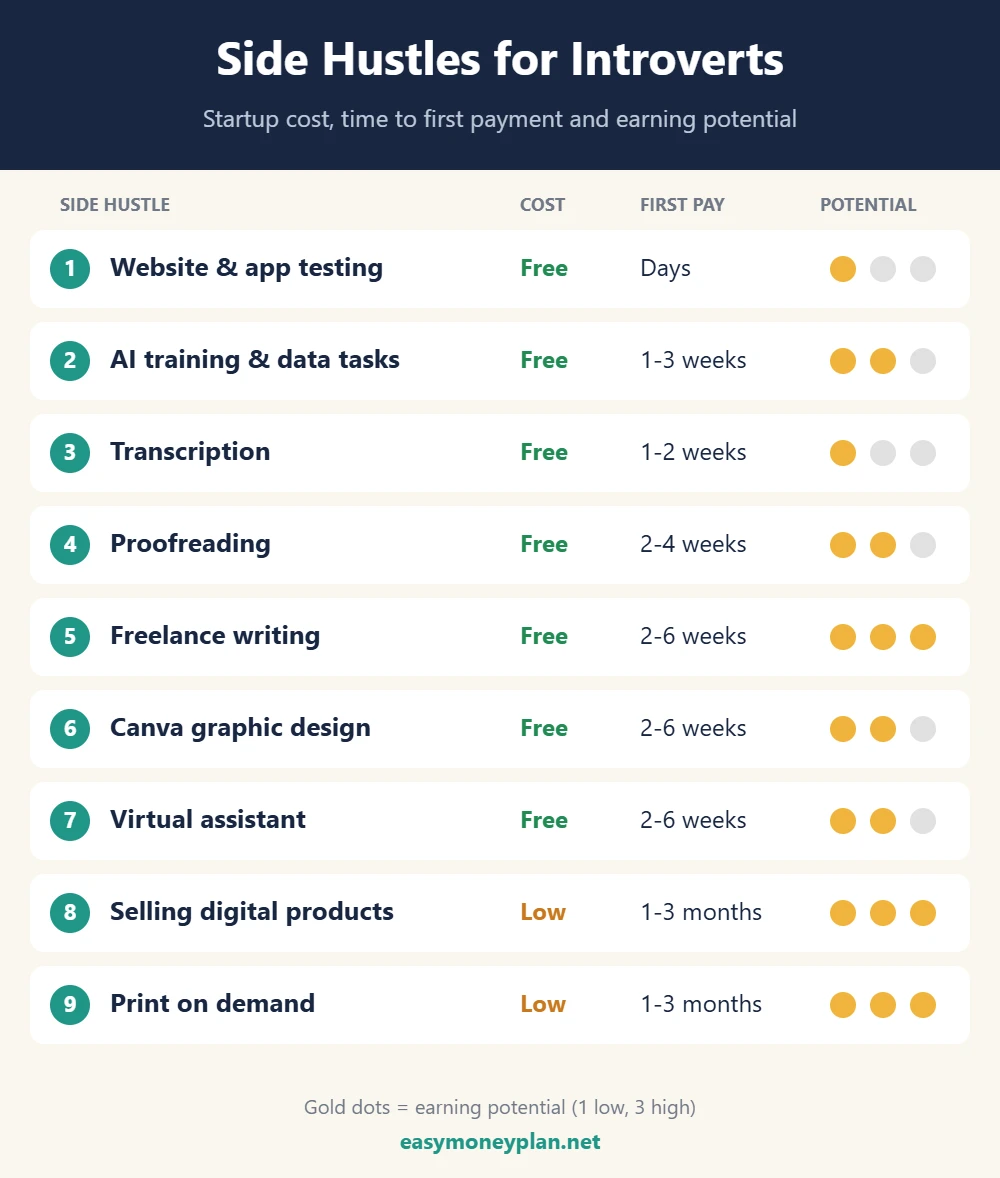
The 9 side hustles at a glance
| Side hustle | Talking to people | Startup cost | Time to first payment | Earning potential |
|---|---|---|---|---|
| Website and app testing | Almost none | Free | Days | Low |
| AI training and data tasks | None | Free | 1–3 weeks | Low to medium |
| Transcription | None | Free | 1–2 weeks | Low |
| Proofreading | Messages only | Free | 2–4 weeks | Medium |
| Freelance writing | Messages only | Free | 2–6 weeks | Medium to high |
| Canva graphic design | Messages only | Free | 2–6 weeks | Medium |
| Virtual assistant (email-based) | Some, mostly written | Free | 2–6 weeks | Medium |
| Selling digital products | None | Low | 1–3 months | Medium to high |
| Print on demand | None | Low | 1–3 months | Low to high |
If you want money quickly, start at the top of the table. If you want something that can grow into real income, look at the bottom half.
9 online side hustles for introverts
1. Website and app testing
Companies pay regular people to use their websites and apps and say out loud what is confusing. You record your screen and voice while completing simple tasks, like finding a product or signing up.
Why it suits introverts: you talk to your screen, not to a person. Live interviews exist, but you can skip them.
Realistic pay: testers commonly report around $10 for a 10–20 minute test on UserTesting, and smaller platforms like Userbrain pay about $5 per test (source). Test availability is unpredictable, so treat it as bonus money.
How to start:
- Sign up on two or three platforms (UserTesting, Userbrain, Trymata).
- Complete the unpaid practice test carefully. It decides whether you get paid tests.
- Keep notifications on, because good tests fill up in minutes.
Full guide: How to get paid to test websites, with pay rates for each platform and tips to pass the practice test.
2. AI training and data tasks
AI companies need humans to rate chatbot answers, label images, and check text. Platforms post small tasks you complete on your own schedule.
Why it suits introverts: it’s pure screen work with zero customer contact.
Realistic pay: usually paid per task or per hour, and rates vary a lot by platform, language and skill. Tasks that need a specialty, like coding or a second language, pay more.
How to start: search for “AI training jobs” or “data annotation jobs”, apply to established platforms, and pass their qualification tests. Never pay to join.
3. Transcription
You turn audio, like interviews, podcasts or meetings, into written text.
Why it suits introverts: headphones on, nobody to talk to.
Realistic pay: beginner pay is low because AI now handles much of the easy work. The better-paid jobs are messy audio, strong accents or specialties like legal and medical.
How to start: practice with free audio clips, learn keyboard shortcuts, then apply to transcription platforms or offer the service on Fiverr.
4. Proofreading
You fix spelling, grammar and formatting in blog posts, ebooks, essays and business documents.
Why it suits introverts: clients send a file, you send it back. Most communication is short messages.
Realistic pay: beginners usually charge per word or per page and raise prices as reviews come in.
How to start:
- Brush up on grammar with a free style guide.
- Create a Fiverr or Upwork profile with a clear before-and-after sample.
- Offer a fast turnaround (24–48 hours) to win your first reviews.
5. Freelance writing
Businesses and websites need blog posts, product descriptions and emails. If you can explain things clearly, you can be paid to write.
Why it suits introverts: you’re judged on your work, not your personality. Many introverts are stronger writers than talkers.
Realistic pay: low at first, but writers who pick a niche, like finance, tech or health, can charge much more over time.
How to start:
- Pick one topic you know well.
- Write three sample articles and publish them on a free Medium page or your own blog.
- Pitch to small businesses and apply on freelance platforms, using your samples as proof.
6. Canva graphic design
Small businesses need social media posts, logos, menus and flyers. With free Canva templates, you can create professional designs without being a trained designer.
Why it suits introverts: you work alone and deliver visuals, with feedback by message.
Realistic pay: simple jobs pay little at first. Packages, like 30 social media posts a month, are where it starts to add up.
How to start: create 5–10 sample designs for imaginary businesses, put them in a portfolio, and list a clear package on Fiverr.
7. Virtual assistant (email-based)
Busy business owners hire assistants to manage emails, schedule posts, update spreadsheets and do research.
Why it suits introverts: choose clients who work by email and chat rather than calls, and say so in your profile.
Realistic pay: usually hourly, and it grows quickly once a client trusts you with ongoing work.
How to start: list the tools you already know (Google Sheets, Gmail, Canva) and offer one specific service, like “inbox and calendar management”, instead of “I can do anything”.
8. Selling digital products
You create something once, like a budget planner, a resume template or a study guide, and sell it many times on Etsy, Gumroad or your own site.
Why it suits introverts: no live selling and no customers to meet. Buyers download the file automatically.
Realistic pay: slow at first, because you need several products and good listings. Over time it can become one of the more passive income streams on this list.
How to start:
- Search Etsy for products in your idea and study the best sellers.
- Make a better or more specific version in Canva or Google Sheets.
- Launch 5–10 products rather than one, then improve the ones that sell.
9. Print on demand
You upload designs for t-shirts, mugs or posters. A print-on-demand company prints and ships each order, and you keep the difference.
Why it suits introverts: no inventory, no shipping and no customer calls.
Realistic pay: profit per item is small, so it takes many designs and some luck to earn well. It works best for niche designs, like hobbies or professions.
How to start: pick one niche you understand, create 20 simple designs, and list them on Etsy or Amazon Merch through a print-on-demand service.
How to choose the right one
Pick based on what you need most right now:
- Need money this month: website testing and AI training tasks.
- Good with words: proofreading or freelance writing.
- Creative and visual: Canva design, digital products or print on demand.
- Organized and reliable: virtual assistant work.
- Want income that grows while you sleep: digital products, but only if you can wait a few months.
Start with one quick-cash hustle plus one long-term hustle. The first keeps you motivated; the second is what builds real income.
Scam red flags to avoid
The “work from home” space attracts scammers. Walk away if a job:
- Asks you to pay a fee to join, train or unlock work.
- Promises a fixed high income with no skills needed.
- Sends you a check and asks you to send part of the money back.
- Moves the conversation to a private messaging app before any contract.
- Asks for your bank login, card details or ID copies at the first step.
Legitimate platforms pay you. They never ask you to pay them to start working.
Frequently asked questions
What is the easiest side hustle for an introvert with no experience?
Website and app testing is the easiest to start. You can sign up today, it needs no skills, and you talk only to your screen. The pay is small, so use it as a starting point.
Can I really start a side hustle with no money?
Yes. Seven of the nine ideas on this list are free to start. You need a computer, an internet connection and free tools like Canva and Google Docs.
Which side hustle pays the most for introverts?
Freelance writing and selling digital products have the highest earning potential. Both take a few months to build, but your income can grow far beyond an hourly rate.
How much time do I need each week?
Five to ten hours a week is enough to get started. Consistency matters more than long sessions: one focused hour a day beats one exhausting weekend.
Do I have to talk to clients?
Rarely. On most freelance platforms, communication happens through written messages. You can state in your profile that you prefer written communication.